
ESPR Milestone 3 Update
The Ecodesign for Sustainable Products Regulation (ESPR), which came into force in July 2024, is set to reshape how products are designed and placed on the EU market by making sustainability a core requirement across the full product life cycle. Textile products were prioritised in the first wave of regulated categories, reflecting both their environmental footprint and their economic importance.
As part of this process, the Joint Research Centre (JRC), the European Commission’s scientific body, is leading the Preparatory Study (PS) to identify eco-design requirements for textiles. Its 3rd milestone, published in December 2025, analysed the life-cycle impacts of denim, knitted, and woven products and proposed the first eco-design options. They also provided a first draft of the eco-design requirements for apparel and textiles. These requirements are not final and are subject to significant changes before the end of the year.
Why this matters for your business
The JRC report provides the scientific basis that will underpin future legal definitions for the eco-design of textile products. That is an important step towards reducing the environmental impact of the apparel sector. However, several gaps remain, and industry consensus has not yet been fully considered. The industry reality, from brands to product design, manufacturing processes, through to recycling sectors, is not well represented. The scoring mechanisms for robustness (think physical strength of a product) and recyclability are often not representative of industry practices and lack sufficient differentiation between product categories such as denim, woven, and knitted products. In addition, the recycled content threshold poses challenges in identifying and verifying recycled materials in garments. Finally, the environmental footprint methodology does not adequately reflect companies' efforts to reduce their environmental impact.
At this stage, it is crucial to engage in the discussion and share brands’ experience with the JRC to adapt the eco-design requirements to the industry's operational realities and the specificities of different products. Stakeholder consultations provide an opportunity to express opinions on the proposal and to supply detailed data to help close the gaps identified in the JRC work.
The general framework of the eco-design requirements can already help brands and suppliers assess the impact on their design and sourcing strategies as well as their ESG product data readiness. It is important to keep in mind that these key topics - robustness, recycled content, recyclability, and environmental footprint - might become central requirements in the coming year. However they should not yet adapt their business models based on the current draft eco-design requirements.
Understanding the JRC’s approach
The new report is founded on a base-case analysis to identify the most environmentally impactful stages in the life cycle of textile products. Using these findings, the JRC proposed eco-design requirements to reduce their environmental impact. The latest update also includes an assessment of substances of concern.
The base case analysis
The JRC conducted an environmental and economic analysis using life-cycle assessment (LCA), applying the Product Environmental Footprint (PEF) and PEF Category Rules (PEFCR) for Apparel and Footwear. The goal was to identify the most impactful stages of the textile life cycle.
Two Life Cycle Stages (LCS) were found to dominate the environmental footprint:
LCS 1 – Raw material production (60–63%): Includes water, energy, chemicals, and direct emissions to water, soil, and air.
LCS 2 – Manufacturing (21–29%): Most impactful processes are fabric finishing, yarn production, and fabric production, mainly due to water and energy consumption.
Based on this analysis, the JRC proposed eco-design options targeting these two stages.
Potential design options
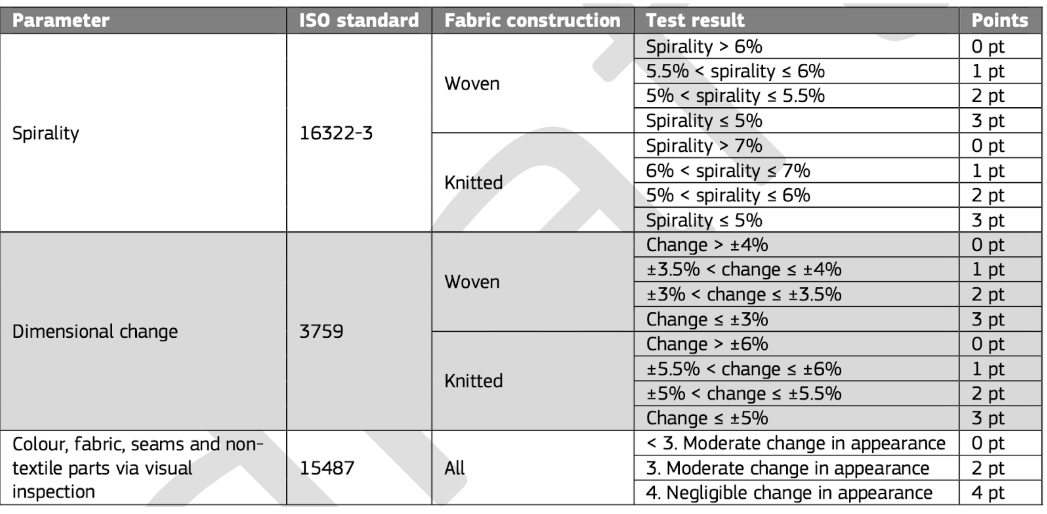
Robustness (information requirement)
The JRC selected robustness as a proxy for physical durability, noting that no standardised test exists to assess textile ageing or intrinsic durability. Focusing on robustness excludes extrinsic durability from the study.
Scoring: 0 to 10 based on three verification criteria: spirality, dimensional change and visual inspection
Recyclability (information requirement)
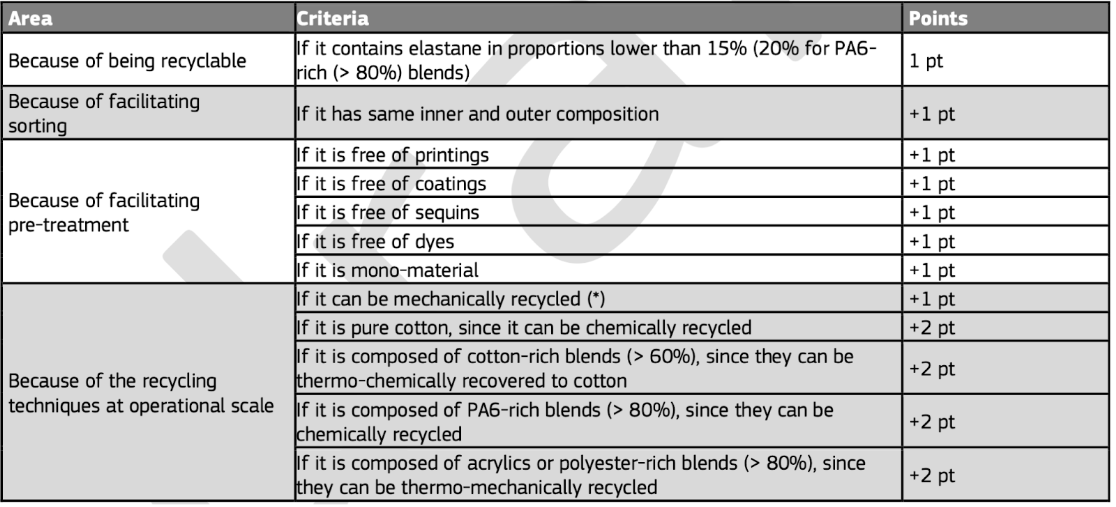
It is defined as the ability of waste textiles to be reprocessed into new products, materials, or substances.
Scoring: 0 to 10 based on four main parameters: being recyclable, facilitating sorting, facilitating pre-treatment and being recyclable through recycling technique operational at scale.
Recycled content (Information and performance requirement)
Mass proportion of recycled fibres from post-industrial, pre- and post-consumer waste in a textile product, now including closed-loop and open-loop recycling (e.g., PET bottles).
Information requirement: Companies would disclose the share of recycled fibres, optionally by source (post-industrial, pre-consumer, post-consumer, open-loop).
Performance requirement: a set of thresholds for denim is 20% of recycled cotton, a threshold for knitted and other woven products is 5% nylon, 10% wool and 15% polyester
Environmental/Carbon footprint (Information requirement)
Disclosure of environmental or carbon footprint for the manufacturing stage (LCS 2) only, on a voluntary basis.
Not a score itself but an indication of whether a product’s impact is above or below the average, rather than showing absolute values.
Substances of concern
Under the ESPR, substances of concern are defined by three regulations: REACH, the Classification, Labelling and Packaging (CLP), and the Persistent Organic Pollutants (POPs). Substances that could negatively affect the reuse or recycling of materials are also included. An information requirement is mandatory when exceeding a specified threshold.
The reporting threshold is generally set at 0.1% w/w for substances regulated under REACH, POP and CLP, with a few substances at 1%. No other substances already regulated have been identified as hindering reuse and recycling.
Next steps in the regulatory process
Following the publication of the JRC’s 3rd milestone, a stakeholder consultation is open until 20 March 2026. The final report is expected in Q2 2026, completing the JRC’s Preparatory Study and paving the way for the European Commission to begin developing the Delegated Act for textile products.
How 2B Policy supports brands and retailers
2B Policy is helping many organisations prepare for a future where the design requirements for placing products on the market is regulated. We help brands and suppliers to:
Track the evolving policy landscape and translate regulatory developments into meaningful actions relevant for their business.
Identify the interconnections between global ESG policies to reduce compliance risks in a pragmatic way.
Assess and prepare the data and process requirements for each legislation, turning policy obligations into operational action.
If you would like to discuss how these developments may affect your products or supply chain, we are happy to support you.
— Aurèlia Bichet (Sustainability and Policy Manager)
