

Leading Industry Solutions
Facilitation
What We Facilitate
Collaborative sustainability initiatives that shape EU policy.
We design and support collaborative sustainability initiatives that bring industry stakeholders together to shape policy approaches, align on methodologies, and accelerate practical implementation.
Through facilitation, governance and coordination, we ensure outcomes are actionable and that diverse industry perspectives are credibly reflected at the policy level. Below are the four initiatives 2B Policy currently chairs or coordinates.
Why This Matters
The rules of the game are being written now.
Sustainability regulation is moving from principle to enforcement, and isolated company action is no longer enough to keep pace. The initiatives below are where industry positions are formalised, methodologies are agreed, and the standards that will define the next decade of compliance are set.
Participating in them or aligning with their outputs gives your business early visibility into upcoming requirements, a credible seat at the table with policymakers, and a shared framework that reduces duplication, costs, and reputational risk.
For brands, suppliers and industry coalitions, this is the most cost-efficient way to influence policy and prepare for compliance in parallel.

Chair · 2019 - Present
Challenge
The EU is moving towards a single, harmonised method for measuring the environmental performance of products under the Ecodesign for Sustainable Products Regulation (ESPR). Without an agreed sector framework, apparel and footwear companies face fragmented methodologies, inconsistent claims, and rising compliance risk.
Our Role
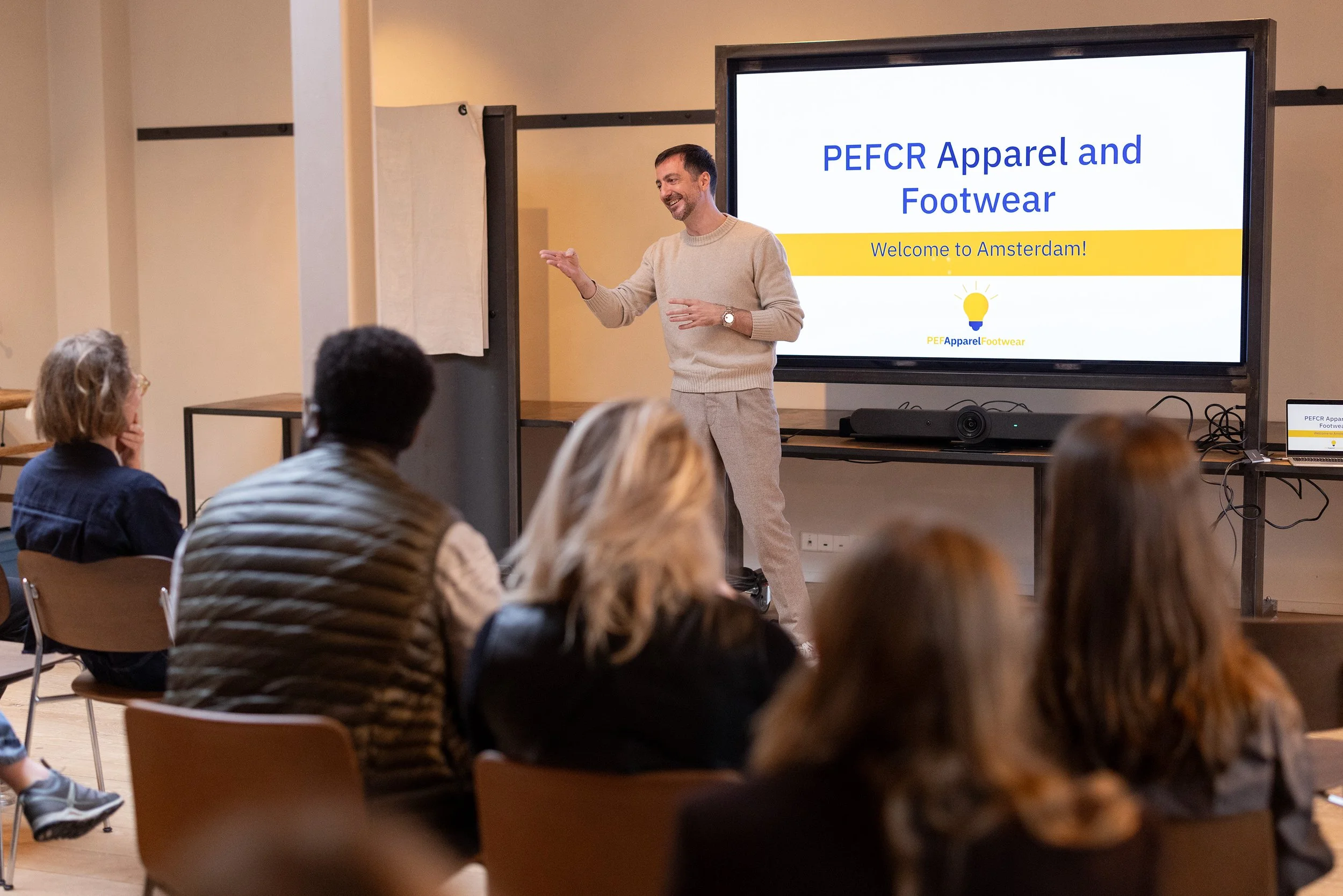
Since the project's inception in December 2019, 2B Policy founder Baptiste Carriere-Pradal has chaired the Apparel and Footwear Technical Secretariat (TS) for the Product Environmental Footprint, with 2B Policy Director of Sustainability and Policy, Emilie Carasso, leading much of the technical and stakeholder work. Together, they coordinated 26 member organisations, representing around half of the European market by turnover, across five years of consensus-building, two public consultations, and numerous independent expert reviews.
Outcome
In April 2025, the TS approved the final PEFCR by qualified majority, covering 13 apparel and footwear product sub-categories. In May 2025, the European Commission gave the green light, and the rules can now be used for compliance with EU legislation that requires an environmental footprint assessment of products. The full documentation is available for download here.

Secretariat & Facilitator
Challenge
Textile-to-textile (T2T) recyclers are essential to closing the loop on textile waste, yet their perspective is consistently underrepresented in EU policy. Without a unified voice, recyclers risk that their interests are not adequately represented in legislation that impacts them.
Our Role
2B Policy facilitates the T2T Alliance, the industry association that brings textile-to-textile recyclers together in the EU policy ecosystem. We coordinate the secretariat function, structure member engagement, and translate technical recycler input into policy positions that regulators can act on.
Outcome
A credible, collective voice for T2T recyclers in EU files, including the ESPR, where the Alliance is supporting the development of mandatory recycled-content requirements for textile products and the structural support on the EU level for secondary raw textile materials. The work is steadily removing regulatory and market barriers that have previously held back the scale-up of textile-to-textile recycling in Europe.
Follow the Alliance on LinkedIn for ongoing updates.


Secretariat · Since 2019
Challenge
The apparel and footwear sector faces a wave of EU circular economy legislation, from ESPR and the Digital Product Passport to Extended Producer Responsibility and the Waste Framework Directive. Without an aligned industry position, companies risk inconsistent advocacy, regulatory surprises, and policies poorly suited to how the sector actually operates.
Our Role
2B Policy staffs the Policy Hub Secretariat, facilitating and managing the initiative's day-to-day work. The 2B Policy management team spent five years before founding the firm growing the Policy Hub from a small group of founding members into a recognised industry body, and continues to coordinate strategy, member engagement and policy positioning.
Outcome
Co-founded by Cascale (formerly the Sustainable Apparel Coalition), the Federation of the European Sporting Goods Industry (FESI) and Global Fashion Agenda (GFA), the Policy Hub brings together a membership representing over 700 brands, retailers, manufacturers and other stakeholders. It is active across the European policy files shaping the future of the sector, from the EU Green Deal and ESPR (where the Policy Hub sits on the Commission's Eco-Design Forum) to green claims, textiles labelling, the Waste Framework Directive and due diligence files such as the Corporate Sustainability Due Diligence Directive and the EU Forced Labour Regulation.
Brands, retailers, service providers, environmental organisations, recyclers and manufacturers can join the Policy Hub to help shape the EU's circular policy agenda.
Learn more at policyhub.org
Winter Sports Equipment PEFCR

Chair · Since 2023
Challenge
Winter sports are uniquely tied to a fragile environment. Snow cover, glaciers, and mountain ecosystems are already shifting under climate pressure, and the industry's long-term viability depends on credibly reducing its own footprint. Yet until recently, brands had no shared, science-based way to measure that footprint.
Existing PEF rules for apparel and footwear did not capture the realities of winter sports equipment: highly technical multi-material products combining composites, metals, and polymers, designed for extreme conditions and long lifespans, with maintenance and end-of-life pathways that differ sharply from everyday consumer goods. Without a category-specific framework, environmental claims risked being inconsistent, incomparable, and vulnerable to greenwashing accusations.
Our Role
2B Policy chairs and coordinates the Technical Secretariat for the development of the Winter Sports Equipment Product Environmental Footprint Category Rules (PEFCR), aiming to standardise how to calculate the environmental impact of skis, snowboards, boots, and helmets across their entire life cycle. Director of Sustainability and Policy Emilie Carasso has been leading the work, with Salomon acting as co-chair, and Glimpact providing technical Life Cycle Assessment expertise.
Over 24 months of intensive collaborative work since 2023, the Technical Secretariat has brought together Atomic, Decathlon, Dynafit, Elan, Fischer Sports, Head, Petzl, the Rossignol Group (Rossignol, Dynastar, Lange, Look), Salomon and the Tecnica Group (Blizzard-Tecnica, Nordica) to ensure industry representation. Two public consultations and an independent third-party critical review provided another layer of robustness to the PEFCR.
Outcome
Published in January 2026, the WSE PEFCR is the first common, PEF-aligned framework for assessing the environmental footprint of winter sports equipment. It gives the industry a shared, scientifically robust language for environmental performance, enabling more accurate eco-design choices, fairer comparisons between products, and credible, verifiable communication to consumers about the impact of what they buy.
Get Involved
Join an initiative, or help us build a new one.
Whether you are looking to join an existing initiative, align your compliance strategy with one of its outputs, or design a new collaborative project for your sector, our team can help you find the right entry point.